Historic Stepwells of Jodhpur: Toorji Ka Jhalra & Beyond
Long before pipes and pumps reached the Blue City, Jodhpur’s water came from the ground up. Scattered across the old city and its outskirts are dozens of stepwells, locally called baoris or jhalras, cut deep into the rock to reach the water table below. The best known of these, Toorji Ka Jhalra, has become a postcard image of Jodhpur in its own right, but it is only one entry in a much larger network. This guide looks at why the city built so many stepwells, what to see beyond the famous one, and how to visit them thoughtfully.
Why Jodhpur Has So Many Stepwells
Jodhpur sits on the edge of the Thar Desert, where rainfall is scarce and unpredictable, and the rocky terrain made digging open wells difficult in many parts of the old city. Stepwells solved both problems at once. By cutting a stepped shaft down to the water table, builders created a structure that stayed accessible even as the water level dropped through the dry months, with the descending steps letting people walk down to whatever level the water had reached. Building and maintaining a stepwell was also, historically, an act of public patronage. Rulers, queens, and wealthy merchants commissioned them as charitable works, and a number of Jodhpur’s stepwells carry the names of the women who funded them, a pattern that continued well into the 18th and 19th centuries.
Toorji Ka Jhalra: The City’s Best-Known Stepwell
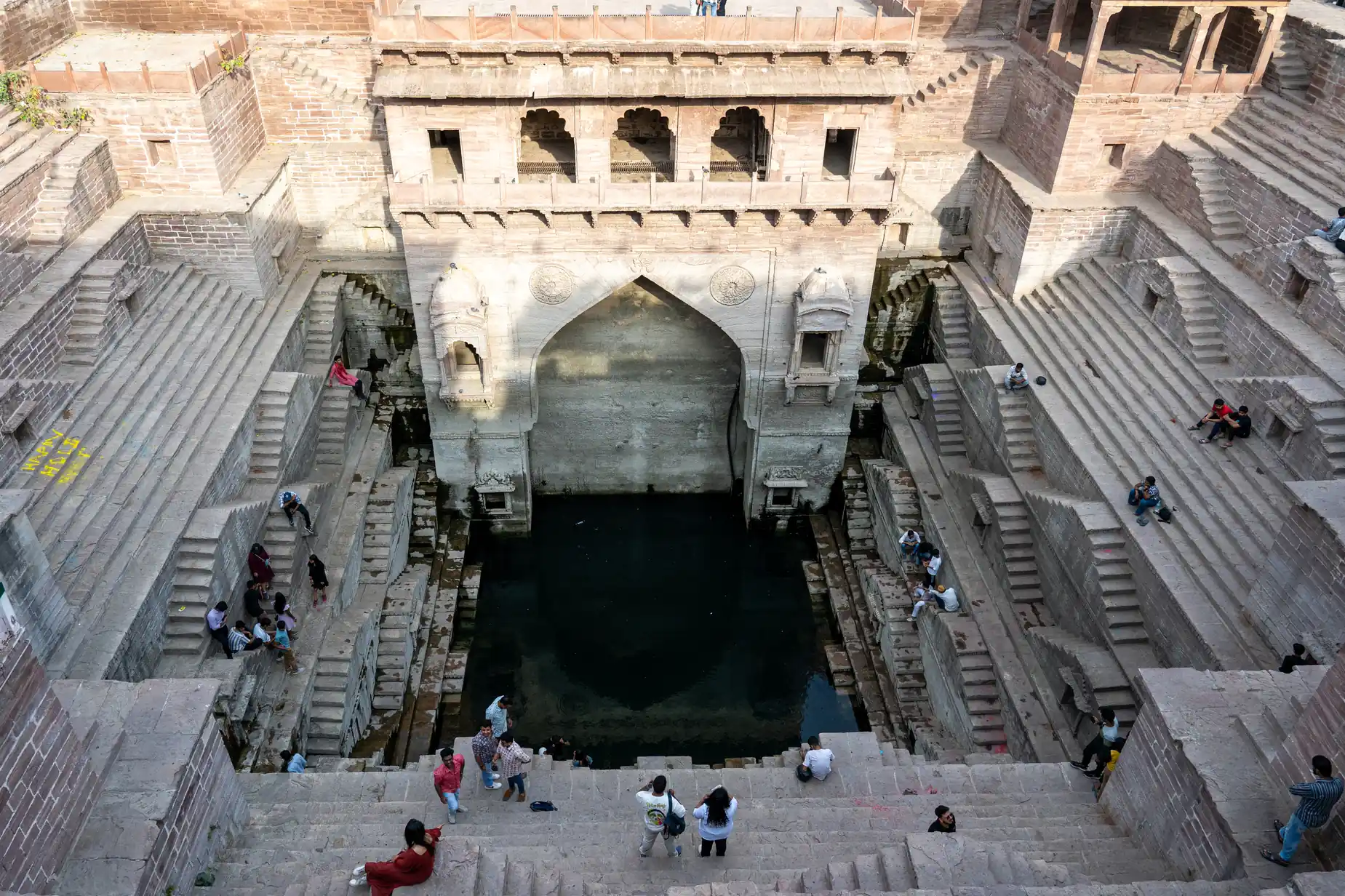
Toorji Ka Jhalra remains the most visited and most photographed of Jodhpur’s stepwells, and it deserves a visit on its own terms. Built on the orders of Maharani Toorji, a queen of Maharaja Abhay Singh, it is cut from red sandstone into a deep rectangular shaft lined with symmetrical terraced steps, now surrounded by cafes and boutique stays that have grown up around it in recent years. Because the stepwell has its own dedicated guide elsewhere on this site covering its history, architecture, and visitor tips in detail, this section keeps things brief. If Toorji Ka Jhalra is the only stepwell on your list, it is worth the visit, but it is far from the only one worth seeing.
Lesser-Known Stepwells Around the City
Beyond Toorji Ka Jhalra, a handful of other stepwells and water bodies in and around the old city are worth seeking out, even if they see a fraction of the footfall.
Gulab Sagar is technically a lake rather than a stepwell, but it belongs in the same story. It is the largest water body in the old city, gifted to Jodhpur by Gulab Rai, a prominent figure in Maharaja Vijay Singh’s 18th-century court. An arched gateway on one side leads through to a small Shiva temple, and the tank still anchors the neighborhood around it.
Mahila Bagh Jhalra sits adjacent to Gulab Sagar, a smaller stepwell that catches the lake’s spill-over water. It has had a harder history than Toorji Ka Jhalra: it was cleaned and restored at one point by an Irish volunteer working in the city, but without ongoing upkeep it has since deteriorated again. It is still worth a short detour if you are already at Gulab Sagar, both for the structure itself and as a reminder that not every stepwell in Jodhpur has been restored to postcard condition.
Tapi Baori is sometimes called Jodhpur’s secret stepwell, tucked away and rarely visited by tourists despite its scale. It was built by Natho Ji Vyas, who served as Prime Minister under Maharaja Jaswant Singh, and its dimensions are considerable: roughly 360 feet deep, 40 feet wide, and 250 feet long. For close to 350 years, it supplied free drinking water to the surrounding neighborhood before piped water made it redundant. Finding it takes a little effort, but it is one of the clearest examples of how seriously stepwell builders took the job of keeping a growing city watered.
Social and Cultural Role of Stepwells
A stepwell was never just a water source. In a desert city, the walk down to the water’s edge was one of the few places where daily routine and public life overlapped, and stepwells became informal community centers as a result. Women gathered here to draw water and exchange news, travelers stopped to rest in the shade of the steps, and the coolest lower levels offered relief from Jodhpur’s punishing summer heat long before mechanical cooling existed. Many stepwells were also built with a religious dimension, often paired with a small shrine or temple nearby, as at Gulab Sagar, which meant a visit to fetch water could double as a moment of daily devotion. That layered role, part infrastructure and part gathering place, is part of why these structures were funded so generously by rulers and patrons across different eras.
Architectural Features to Look For
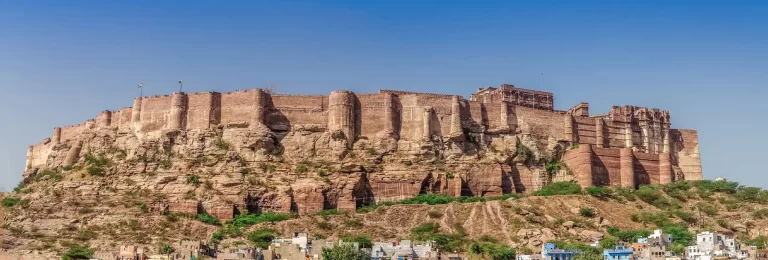
Jodhpur’s stepwells share a family resemblance even where their scale differs. Look for the symmetrical flights of steps descending toward the water, usually cut so that the well remains usable at multiple water levels through the year. Sandstone is the dominant building material across the city, giving most stepwells the same warm, slightly rough-textured surface as Mehrangarh Fort and the old city’s havelis. Arched gateways and small pavilions often mark the entrance, and carved detailing, though generally simpler than what you would find on a palace or temple, still turns up around doorways and column capitals. At larger stepwells, terraces and platforms at different levels were built to let people pause partway down rather than making the full descent every time.
Visiting Etiquette and Practical Tips
Most of Jodhpur’s stepwells are free to visit and open through daylight hours, though Toorji Ka Jhalra’s surrounding cafes keep the area lively well into the evening. Sturdy, closed footwear is worth wearing, since the stone steps can be uneven and slippery, especially after rain or early morning dew. Some of the lesser-known stepwells, including Mahila Bagh Jhalra and Tapi Baori, are not set up for tourists in the way Toorji Ka Jhalra is, so keep noise down and be mindful that local residents may still use these spaces day to day. Photography is generally fine at all of them, but it is worth asking before photographing people who are drawing water or resting nearby.
Best Time of Day and Year to Visit
Early morning and late afternoon are the best times to see any of Jodhpur’s stepwells, both for softer light and for cooler temperatures on the stone steps. Toorji Ka Jhalra’s cafe scene comes alive in the evening, making it a good stop for sunset even if you visited earlier in the day for photographs. Across the cooler months from October to March, the steps are far more comfortable to walk than during Jodhpur’s peak summer heat, when the exposed upper sections of some stepwells can get too hot to linger on for long.
Combining Stepwells with Old City Walking Tours
Because several of Jodhpur’s stepwells sit within walking distance of each other in the old city, they slot naturally into a walking route rather than needing a separate outing each. Toorji Ka Jhalra and Gulab Sagar are both reachable on foot from the clock tower market area, and a route connecting the two can easily be folded into a broader old city walk that also takes in the bazaars, havelis, and blue-painted lanes the neighborhood is known for. Tapi Baori sits further off the usual tourist path, so it works better as a deliberate stop with a guide or clear directions than as something you stumble onto along the way.
What Local Residents Use Stepwells For Today
Piped water has replaced stepwells as Jodhpur’s primary water source, but that has not made these structures obsolete in daily life. Around Toorji Ka Jhalra, the stepwell itself has become a public gathering spot in a new form, ringed by cafes and shops that draw both residents and visitors. At the quieter stepwells like Mahila Bagh Jhalra, some local use for washing and water collection continues in a smaller way, particularly where municipal supply is less reliable. And across the city, stepwells that have fallen out of practical use still function as shaded rest spots and informal meeting points, carrying forward, in a much reduced form, the same social role they served for centuries before taps arrived.
FAQ
What is Jodhpur’s most famous stepwell?
Toorji Ka Jhalra is the best-known and most restored stepwell in the city.
Are there other stepwells besides Toorji Ka Jhalra?
Yes, smaller lesser-known stepwells exist scattered through the old city and surrounding areas.
Why were stepwells built in Jodhpur?
They provided a reliable water source in the arid Marwar region before modern plumbing.
Can visitors enter the water level of the stepwells?
Access varies by site; Toorji Ka Jhalra allows visitors close to the water’s edge safely.
Is visiting stepwells worth the time on a short trip?
Yes, they offer a quick, distinctive stop that differs from the fort and palace sightseeing.